
Feed Your Family Full Meals All Month — Even the Last 10 Days Before Salary

You know the sound. The scrape of the spoon against the bottom of an almost-empty rice bag, day nineteen of the month, and you're doing the math in your head again before you've even started cooking.
You tilt the oil bottle all the way to the side, watching it thin to a trickle, calculating whether it will stretch to Friday or whether you'll have to "manage" with less oil in the stew tonight — again.
You've started doing something you never imagined you'd do. You dish out the food, make sure every plate at the table is full, and then quietly tell your husband you already ate while you were cooking. He believes you. The children believe you. Only your stomach knows the truth.
By day twenty, you're not just budgeting anymore — you're rationing. Protein becomes a Sunday thing. Snacks disappear from the house entirely. You start recalculating a soup pot you've already portioned three times, wondering if you can somehow make it stretch one more day.
And the worst part isn't even the hunger. It's the performance. Smiling at the table. Telling your husband "we're managing fine" when what you mean is that you cried quietly in the kitchen that morning, staring at a fridge that has less in it than it did a week ago.
You've tried. You really have. You downloaded a budgeting app once — built for someone earning three times what your household brings home, with categories for "dining out" and "entertainment" that made you close it within a day.
You've asked your mother, your aunties, the older women in your compound, and they all say the same thing: "just manage well." Nobody tells you exactly what that means. Nobody hands you numbers. Nobody tells you what to actually put in the pot on day twenty-six when the money is finished but the month is not.
So you've borrowed. From the woman who sells provisions down the road. From a neighbor, quietly, hoping your husband never finds out. You've told yourself it's temporary, that next month will somehow be different — but next month arrives, and by day twenty it looks exactly the same.
You are not lazy. You are not bad with money. You are a mother doing arithmetic that doesn't add up, with a system that was never built for a household like yours in the first place.
Here's what changed it for me.
You don't need a bigger salary to feed your family completely all month. You need a practical Nigerian household system that tells you, in real naira, exactly what to cook every single day — including the last ten.
My Real Story
My name is Blessing Adeyemi. I'm 33 years old, and I live in Ibadan, Oyo State, with my husband and our four children. My husband works in the civil service, and I do tailoring on the side whenever jobs come in — which, if I'm honest, was never regularly enough to close the gap that opened up every single month before the twentieth arrived.
For years, I thought the problem was me. I thought if I was just a little more disciplined, a little better at "managing," the food would somehow last. So I tried everything the way everyone else seemed to try things. I downloaded a budgeting app that a friend recommended — the kind with categories for restaurants and gym memberships and things that had nothing to do with my reality. I opened it, stared at it for ten minutes, and closed it. It wasn't built for a house like mine.
I asked the older women around me — my mother, my husband's aunty who lives two streets away, the women at church who always seemed to have their homes running smoothly no matter what. They all gave me the same advice, and they gave it with love: "just manage well, my dear." But nobody ever sat me down and told me what that actually meant in numbers. Nobody told me how much I should be spending per day, per week, on what. It was wisdom without a system — true, but useless when I was standing in the kitchen at 7pm with four hungry children and half a bag of rice.
So I did what I think a lot of us do quietly. I started cutting from myself first. If there wasn't quite enough protein to go round properly, I would serve the children and my husband first, and tell him I'd already eaten while I was cooking. He believed me, because why wouldn't he? I said it with a smile. But I hadn't eaten. I was hungry, and tired, and doing arithmetic in my head that never seemed to balance.
By the third week of most months, the salary was finished, but the calendar wasn't. I remember one particular month — it was harmattan season, the children needed extra food to stay warm and fed for school — and by day twenty-two, I found myself walking down to the woman who sells provisions on our street, asking if I could "take small thing and pay later." She was kind about it. But walking home that day, I felt something break a little in me. I was a full-grown woman, a mother of four, and I was borrowing garri on credit because I didn't know how to make the money we did have stretch the distance it needed to stretch.
That night, after everyone had gone to bed, I sat at the kitchen table with a pen and an old exercise book, and I did something I had never actually done before. I wrote down, honestly, exactly how much money came into this house in a month. Then I wrote down, day by day, what I had actually spent on food. And when I laid it out like that — not as a vague feeling of "things are tight," but as real numbers on a real page — I could suddenly see exactly where the month was breaking. It wasn't that we didn't have enough, overall. It was that I was spending unevenly. Too much in the first two weeks, when the salary felt new and generous, and almost nothing left by the time the month's final stretch arrived.
That was the moment everything shifted for me. I hadn't been failing at managing money. I had never actually had a system — just instinct, guesswork, and hope.
Once I saw it that clearly, I couldn't unsee it. I started experimenting. I split the month's food money properly across all thirty days instead of spending it the way it "felt" right week to week. I built a simple calendar — what to cook on which day, based on exactly what I could afford that week, with protein built in every single time instead of treated as a luxury. I started shopping with actual price lists in hand instead of walking into the market and guessing. And I built in a plan specifically for the danger zone — those final ten days that used to be the hardest — so I was never caught by surprise again.
The real test came the following month, on day twenty-five. In the old system, day twenty-five was always the day the house went quiet — smaller portions, thinner soup, everyone pretending not to notice. This time, I served a full pot of jollof rice with real pieces of meat in it, on day twenty-five, and nobody at that table knew anything had ever been different.
My husband noticed first. He looked at his plate, then looked at me, and asked what had changed — because in previous months, by that point, he'd have quietly noticed the meals getting smaller, even if neither of us said it out loud. I told him the truth: I had finally built a system that told me exactly what I could afford to cook, every single day of the month, instead of guessing and hoping and quietly going without.
I didn't stop there. I refined it. I tested it across different months, different seasons, different amounts of income — because some months the tailoring brings in a little extra, and some months it brings in nothing at all. I built it into three budget tiers, so the system flexes with whatever the household actually has that month, instead of assuming every family's number looks the same. I turned my scattered exercise-book notes into a full calendar, a proper shopping list, and a reusable template I could use again every single month going forward, without starting from zero each time.
What I built wasn't a diet plan, and it wasn't complicated. It was the thing nobody had ever actually handed me: a practical, honest, day-by-day system, built specifically around a real Nigerian household salary calendar — not a generic app, not vague advice, not another version of "just manage well" with no numbers behind it.
I'm sharing it now because I know I am not the only woman doing this quiet arithmetic at her kitchen table at night. If any part of my story sounds like your Tuesday evening, I built this for you.
Introducing The Manage-Well Method
The Full-Pot System for Feeding Your Family Completely All Month — Even the Last 10 Days Before Salary
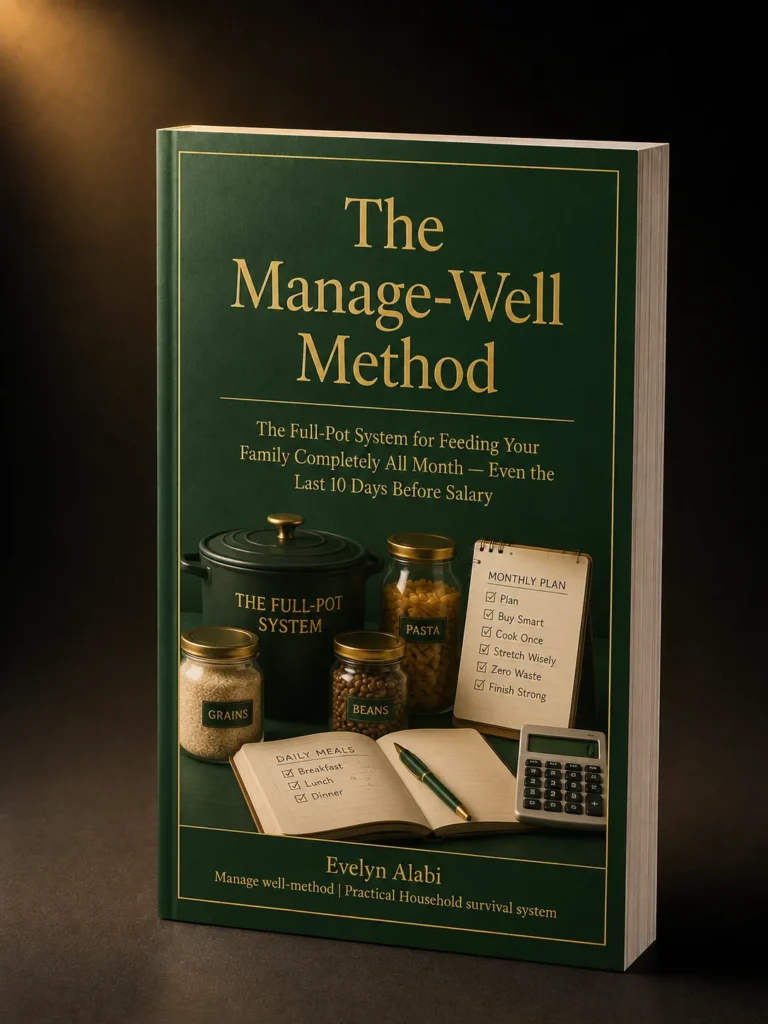
What's Inside The Manage-Well Method
The Salary Split Calculator
Turn this month's real income into an instant daily food budget — know your number in the first 15 minutes.
The Danger Zone Self-Check
Spot a coming crisis before day 28 arrives, instead of discovering it with an empty pot.
The 30-Day Meal Calendar (3 Budget Tiers)
Know exactly what to cook, every single day — built to flex with whatever your household actually has that month.
The Weekly Market Shopping List
Shop by tier, with real price guidance, so you stop guessing and overspending in the first two weeks.
The Never-No-Protein Stretch Guide
Keep real protein on the plate every single day — even in the tightest week of the month.
The Reusable Monthly Planning Template
Run the whole system again next month, and every month after, in minutes instead of starting from zero.
What Other Mothers Are Saying
Funke A.
★★★★★
Nice book i just purchased it
Chinyere O.
★★★★★
Helped in managing my shopping spending
Here's Everything You're Getting Today
Regular Price: ₦19,600
₦9,800
One-time payment. Instant access. No subscription.
⚠ Only the first 30 people today get this launch price
Secure checkout. Instant digital delivery.
Plus, Two Fast-Action Bonuses
Included free when you get The Manage-Well Method today.
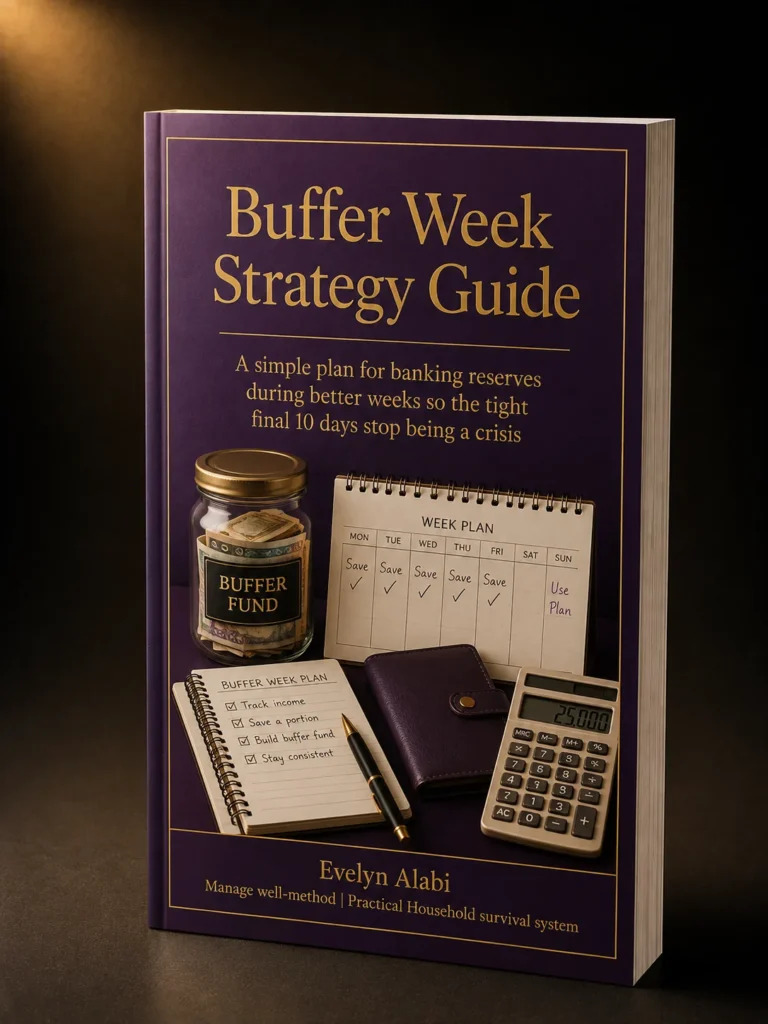
BONUS 1
The Buffer Week Strategy Guide
A simple plan for banking small reserves during your better weeks — so the tight final ten days stop being a crisis you dread and become just another part of the plan.

BONUS 2
The Danger-Zone Rescue Kit
A printable one-page emergency stretch plan for the moment day 25 arrives and the pot is already running low — so you always know exactly what to do next, without panic.
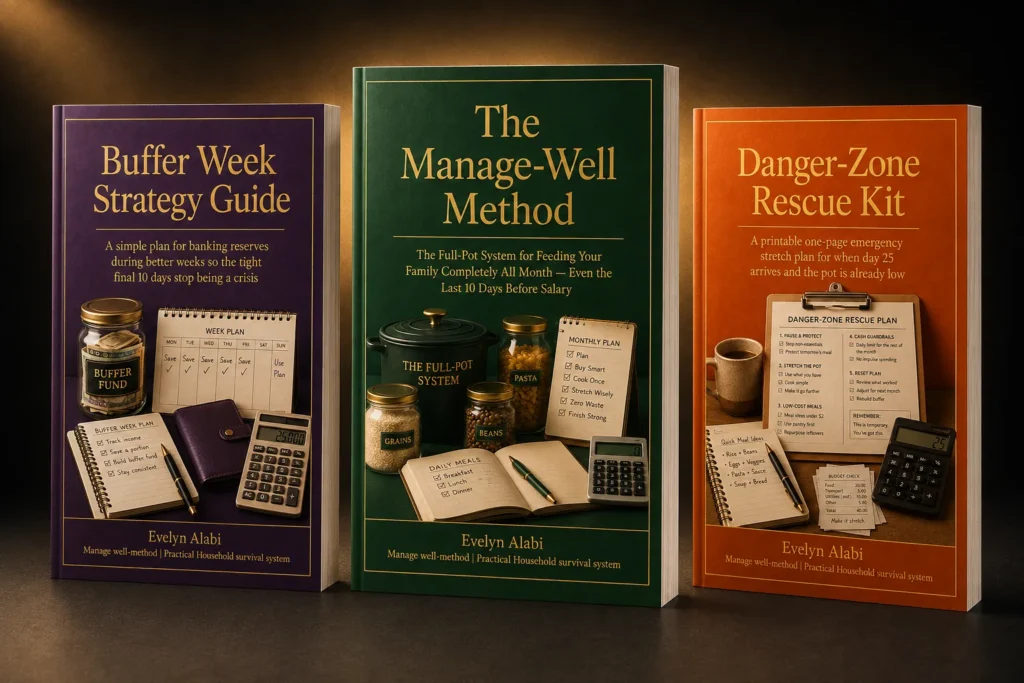
First 30 buyers only. Price returns to ₦19,600 after.
🛡️
The First-Month Peace of Mind Guarantee
Run the Salary Split Calculator with your real numbers this month, and follow your tier's meal calendar for the full 30 days. If your family goes without a complete meal because of this system, write to us and get a full refund — no argument, no hard feelings.
Two Ways The Rest Of This Month Can Go
You already know what day twenty looks like without a system. You've lived it more times than you can count. The tilted oil bottle. The quiet "I already ate." The walk to the provisions shop to ask for credit you'll spend the next two weeks trying to repay.
Keep guessing
Another month of stretching by instinct, hoping it somehow works out, and quietly going without so the children don't notice.
Take control today
Fifteen minutes with the Salary Split Calculator, and you know — in real naira — exactly what your family eats every single day this month.
Picture day twenty-five, next month. The pot on the stove still has meat in it. Nobody at your table is eating smaller portions than they did on day one. And you're not sitting alone in the kitchen, doing arithmetic that doesn't add up — because the arithmetic is already done, sitting in a calendar taped inside your cupboard.
That's not a bigger salary. That's a system. And it's ready for you right now.
Instant access. First-month guarantee. First 30 buyers only at this price.