
Student work-hour compliance
Find Out in 10 Minutes If Your Work Hours Break Your UK Student Visa Rules
The story on this page ("Chioma's situation") is a representative scenario built from common situations reported by multi-job students — not a real customer case.
A practical system for UK international students working multiple jobs who want a clearer way to understand, calculate and track their permitted working hours.

You came to the UK to study.
That part was always going to be the hard part — new city, new course, new system. You were ready for that.
Then rent went up.
Groceries cost more than you budgeted for in September. Your family sends what they can, when they can, but the exchange rate doesn't always cooperate, and you don't want to ask for more than you have to.
So you take another shift. Maybe a second part-time role, maybe some delivery or gig work on the side. It helps. It also means you now have two rotas, two employers, and two sets of payslips to keep straight — on top of lectures, seminars and deadlines.
Then you realise something: your Student visa conditions don't just apply to one job. They apply to your working pattern as a whole.
Now the simple question becomes complicated. Do the hours from both jobs get added together? Does the week start on a Monday or a Sunday for the purpose your provider uses? What happens to a shift that crosses midnight — does it count toward this week or next? Does gig work count the same way as a payslip job? And what does your university's own term calendar have to do with any of it?
You've probably already tried to find a straight answer. Maybe you asked your employer's HR team. Maybe you read the official guidance cover to cover. Maybe you asked in a student WhatsApp group, and got three different answers from three different people — each one confident, each one different.
None of that is a criticism of you. It's a genuinely confusing area to apply to a real, messy, multi-job week.
Here's what changed it: instead of trying to remember everything or relying on conflicting opinions, the problem could be turned into a simple process.
The goal is simple.
Help you understand the relevant rules, apply them to your own working pattern, track your hours as you go, and know exactly when a situation needs professional advice rather than guesswork.
Adeyemi Ola
Why I built this
I'm going to be straightforward about where this guide came from, because I think transparency matters more than a dramatic backstory.
This didn't come from a single dramatic incident. It came from noticing the same practical gap over and over, in the same conversations, among the same group of students: UK international students — a lot of them Nigerian students, specifically — juggling more than one job to make their budget work.
The official guidance on student work restrictions exists, and it's accurate. That's not the problem. The problem is that official guidance is written to be correct, not to be applied. It tells you the rule. It doesn't walk you through what happens when your rota from Employer A overlaps with a shift from Employer B, or when your course moves from term time into a reading week that doesn't feel like a "holiday" in the way the rule assumes.
So students end up doing one of a few things.
They ask their employer's HR department — reasonable, except HR is generally set up to answer questions about pay, rotas and workplace policy, not to interpret someone's individual immigration conditions across two separate jobs.
They read the official guidance carefully, sometimes more than once — and it's genuinely well-written, but it's written for the general case, not for "what happens when my food-delivery hours overlap with a retail shift that starts before midnight and ends after."
They ask in a student WhatsApp group — where somebody almost always answers with total confidence, even though that person's course, visa conditions, or employer situation might be completely different from theirs.
Or they just try to keep track of it all in the Notes app, which works for about two weeks before the hours get scattered across different notes, different weeks, and different apps, and nobody can reconstruct what actually happened in week six of term.
None of those are bad instincts. They're just not built for the actual problem, which is a tracking and application problem as much as it is a "what does the rule say" problem.
Once I saw the pattern clearly, the fix wasn't complicated — it just needed to be built properly, once, instead of re-derived by every student from scratch. I organised it into three phases that mirror how the problem actually shows up in real life:
Diagnose — understand the rules that actually apply to your situation, in plain English, including the parts that trip people up: what counts as a "week," how term time and vacation periods are treated, and what generally counts as work.
Apply — take those rules and apply them to a real, messy week: split shifts, two employers, overlapping schedules, and a running weekly total you can actually check against.
Maintain — turn that into a habit rather than a one-off exercise, so you're checking in at sensible points (like the start and end of a term) rather than discovering an issue by accident months later.
That structure — Diagnose → Apply → Maintain — is the entire mechanism behind this guide. Nothing about it is designed to replace the official rules, and nothing about it is designed to replace a qualified adviser when your situation genuinely needs one. It's designed to sit between "I've read the rule" and "I actually know where I stand this week," which is the exact gap most multi-job students fall into.
That is why I packaged the process into a practical guide.
The guide
Stay Legal, Stay Enrolled
The UK student work-hour compliance kit for multi-job students.
It's a practical, plain-English kit built specifically for international students working more than one job or gig role — not a general overview of student visa rules, and not a substitute for personalised immigration advice. It's the working system that sits underneath those rules, so you can apply them to your actual weekly schedule with confidence.

What's inside
Six practical tools, not a wall of theory
Page 3
Plain-English Rulebook
What counts as "term time" versus "vacation," and what actually counts as a week — explained without the legal density.
Page 7
"What Counts as Work" Checklist
A practical checklist for reviewing different types of paid and unpaid activity against your working pattern.
Page 12
Multi-Employer Worked Examples
Real worked-through examples covering split shifts and overlapping weeks across more than one employer.
Page 16
Term-Time vs Vacation Calendar Template
A planning template so you always know which set of rules applies to the week you're looking at.
Page 19
Fillable Weekly Hours Tracker
A practical tool for logging hours across employers so your weekly total is always one glance away.
Page 23
"If You've Gone Over" Action Checklist
A structured checklist for reviewing the situation calmly and identifying the appropriate next step.
The method
The 3-Phase Compliance System
Every part of the guide maps onto one of these three phases — so you always know what you're doing and why.
01 — DIAGNOSE
Understand the relevant rule
Work through term time vs vacation, what counts as a week, and what counts as work — in plain English, applied to your situation.
02 — APPLY
Calculate and record your hours
Use the worked examples and weekly tracker to handle multiple employers, split shifts and overlapping schedules.
03 — MAINTAIN
Keep your records and review changes
Build a repeatable check-in habit — end-of-term reviews, updates when your schedule changes, and a clear next step if something looks off.
This guide is for you if…
This guide is not for…
Real student feedback
Coming soon
We're collecting genuine feedback from students who've worked through the guide. Rather than manufacture reviews, we'll publish permission-based student experiences here as they come in.
The complete kit
Everything included in Stay Legal, Stay Enrolled
One-time payment. Instant digital access.
Main guide + 2 practical bonuses + 30-day peace of mind guarantee
Included at no extra cost
Two bonuses that make the system easier to put into practice
Bonus 1
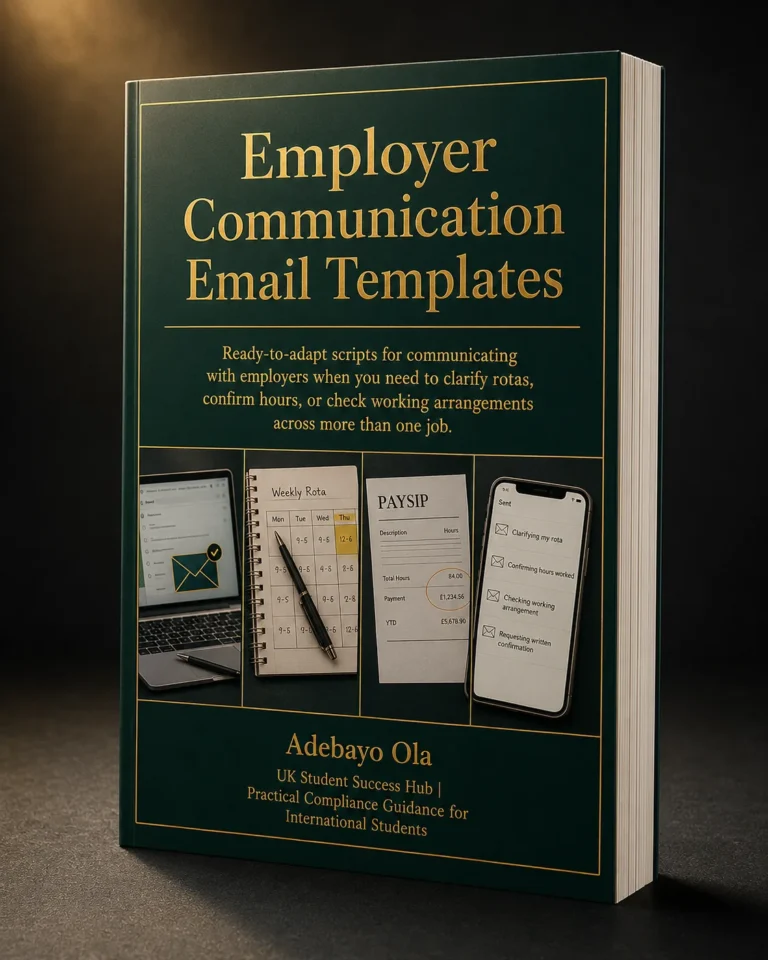
Employer Communication Email Templates
Ready-to-adapt scripts for communicating with employers when you need to clarify rotas, confirm hours, or check working arrangements across more than one job.

Bonus 2
Vacation-Break Max-Earning Guide
A practical planning resource for understanding how working during vacation periods differs from term time, so you can plan your available hours responsibly.

Common questions
But I still have questions…
Can I just ask my employer?
You can, and it's often a useful step — but employer HR teams are generally set up to answer questions about workplace policy and pay, not to give personalised immigration advice about how your specific visa conditions apply across more than one job.
Can't I just read the official guidance?
You should — official guidance remains the authoritative source, and this guide doesn't replace it. What it does is help you organise and apply that information practically to a real, multi-job week.
What if I work for two employers?
That's exactly what this guide is built for. The worked examples and weekly tracker are specifically designed around multi-employer tracking, split shifts and overlapping schedules.
What if my situation is complicated?
Some situations do need individual attention. If yours is one of them, the guide points you toward qualified immigration advice and your university's international student support team.
What if I discover a problem?
The "If You've Gone Over" action checklist walks you through reviewing the situation calmly and identifying the appropriate professional or university support to contact next.
30-Day Peace of Mind Guarantee
You should feel that this guide has genuinely made your compliance position clearer. If it doesn't, you can request a full refund within 30 days.
This guarantee relates to the clarity the guide provides — it is not a guarantee of any particular immigration, visa, or enrolment outcome.
You don't need another WhatsApp opinion.
You need a practical process.
Understand the rules that actually apply to you.
Apply them to your real, multi-job week.
Track your hours as you go, not from memory.
Review your position at sensible points in the term.
Know exactly when it's time to ask for professional help.
That's what Stay Legal, Stay Enrolled is built to give you.
Stay Legal, Stay Enrolled
Main Guide + 2 Practical Bonuses + 30-Day Peace of Mind Guarantee