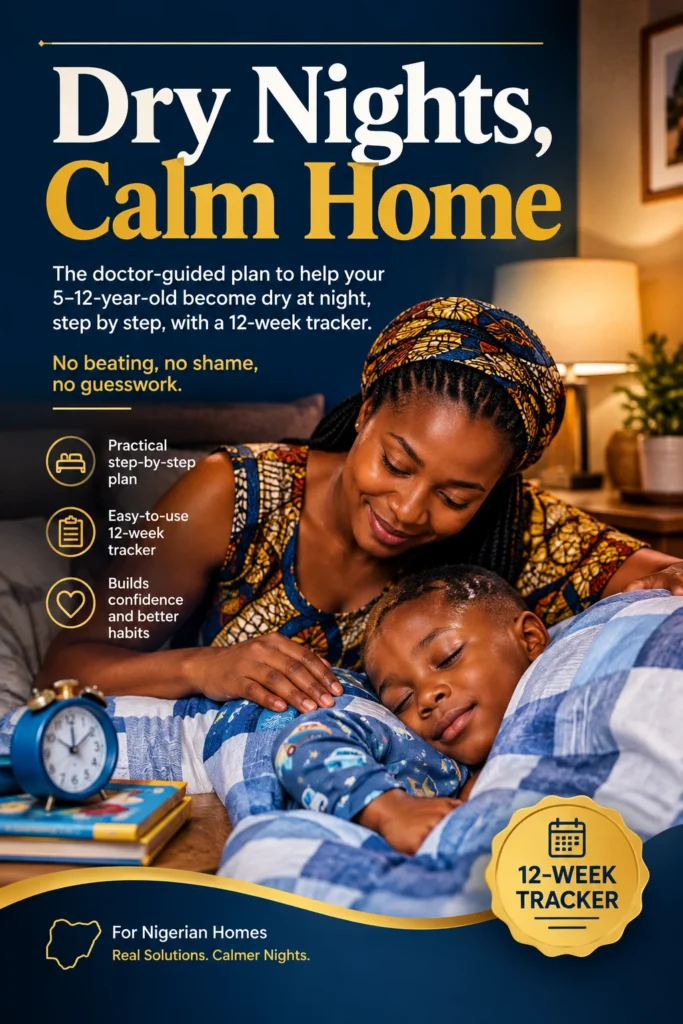
A calm, step-by-step plan — based on the same guidelines doctors follow — to help your 5–12-year-old become dry at night. Built for a Nigerian home: NEPA, Grandma, the house help, school runs and all.
Get the Plan — ₦4,700Instant PDF download·7-day money-back guarantee·No subscription
Reviewed by Dr. Inimgba Nestor

Maybe it's the 2am alarm you set on your own phone, so you can carry him to the toilet half-asleep — only to find the sheet wet again by morning anyway. Maybe it's cutting off water after 6pm, and watching him go to school thirsty for nothing. Maybe it's the GP who looked at your file for two minutes and said, "he'll outgrow it," and sent you home with no plan at all.
Meanwhile, everybody in the house has an opinion. Grandma says he needs "a proper cane," or hints that somebody is "doing" him. Your husband thinks the boy is simply lazy. You suspect, quietly, that none of that is true — but you're the one stripping the mattress every morning, and you're tired.
And underneath the exhaustion is a real fear: he's due for JSS1 boarding school, or his first proper sleepover, and this is going to follow him there. You don't want him laughed at. You don't want to be the parent who did nothing.
Bedwetting at 5–12 is common, well studied, and treatable in most children — but the guidance that actually works (published by paediatric bodies like NICE and the International Children's Continence Society) is written for the NHS, in language built for clinicians, with none of the context that makes it usable in a Lagos flat with NEPA taking light at 2am, a live-in help, and a grandmother who has strong opinions about the cane.
The honest promise: a step-by-step plan, based on published medical guidelines, that helps most children become dry within about 6–16 weeks of consistent use. It tells you clearly when a doctor needs to be involved. And it gets your husband, your mother-in-law and your house help working from the same page instead of five different ones.
No 7-day miracle. No "cure." No pill hidden in the PDF. Just the method with the strongest evidence behind it — the bedwetting alarm — turned into a routine a busy Nigerian household can actually follow, alongside the daytime habits and family scripts that make it work.
This isn't a guess dressed up as advice. Every method in the guide comes from published clinical guidance, and every statistic is referenced at the back.
The plan follows the UK's NICE guideline on bedwetting (CG111), guidance from the International Children's Continence Society, and Cochrane's review of alarm treatments — the same evidence a paediatrician would draw on.
One Nigerian hospital study found 37% of children aged 6 and above still wet the bed. Studies from Enugu, Calabar, Anambra and the southwest confirm it's common here — and that punishment often makes it worse, not better.
Bedwetting alarms are the first-line treatment recommended by NICE. About 2 in 3 children who use one properly become dry, and they're less likely to relapse than children who use medication alone.
The author isn't a doctor and doesn't claim to be. Every medical statement in the guide is one you could take to your own paediatrician and ask about directly.
By someone who's been there. I'm not a doctor. I built this guide because the good information on bedwetting was scattered, foreign, or buried under myths — and Nigerian families deserved something written for their actual homes. Every medical claim inside is referenced from published guidelines and research, listed in full at the back of the guide. If your child's situation is unusual, this guide will tell you plainly when to see a doctor instead of guessing.
Reviewed by Dr. Inimgba Nestor.
| What most families try | What actually happens |
|---|---|
| Cutting off water after 6pm | He gets thirsty and cranky. The bladder isn't trained to hold more — it just makes him miserable during the day too. |
| Waking him at 1–2am to "lift" him | He pees half-asleep. It can reduce wet sheets short-term, but it doesn't teach the brain to wake on its own. |
| Pull-ups at 8–10 years old | Useful for travel, but worn every night it can quietly signal "we've given up," and it doesn't move him toward dryness. |
| Scolding or the cane | He can't control this while asleep. Stress and fear are linked to more wetting, not less — and it damages his confidence. |
| An alarm bought with no instructions | Most families quit in week two because nobody told them what "week two" is supposed to look like. This guide is the missing instructions. |
A 40–45 page guide, written to be read on your phone in traffic, plus a printable tool pack you can use straight away.
A single private consult in Lagos runs ₦15,000 and up. A bedwetting alarm alone costs ₦25,000–₦45,000. This guide is what makes either of those actually work — for less than a tenth of the alarm's price.
The core guide above is everything you need to begin. If you want extra help along the way, these become available as an upgrade after checkout:
A 6-month countdown to resumption, a script for the matron or housemaster, a discreet kit checklist, and a backup plan if he isn't fully dry by then.
Value: ₦7,500
A filled-in example of the prep sheet, the questions worth asking, and how to get more than "he'll outgrow it" out of an appointment.
Value: ₦4,500
A short read-aloud story for your child, about a boy learning to hear his body's signal — written to take the shame out of the room.
Value: ₦5,000
A private accountability group for the hard first month, when most families quit the alarm programme.
Included at a higher tier
Total value above: ₦17,000. You'll see these as an optional upgrade right after you get the core guide — nothing to decide right now.
Yes — deep sleepers are the most common case, not the exception. Section 5 covers exactly what to do in the first two weeks when your child doesn't wake to the alarm, including the vibration and wireless-receiver options for families in the same situation.
No. The guide's position is simple: pray for your child, and follow the plan. The two aren't in competition. There's a short, respectful section specifically for families navigating "is it spiritual or medical?"
Section 4 gives you word-for-word scripts for both conversations, including what to say when someone insists on the cane or a spiritual explanation. You're not on your own for that conversation.
Every method in this guide is drawn from published clinical guidelines (NICE, ICCS, Cochrane), listed by name at the back with full references. The author is upfront about not being a doctor. There's no "cure," no countdown timer, and no claim you can't check yourself.
Most children improve with consistent use over 6–16 weeks, but not every child responds the same way, and the guide says so plainly — including exactly when to stop and see a doctor instead of continuing to guess. If the guide isn't right for you, you're covered by the 7-day money-back guarantee.
No. Start with Section 3, the daytime foundations — some children improve with those changes alone. The alarm programme in Section 5 is there for when you're ready, with full guidance on choosing one in Nigeria.
Every week you wait is another week of wet sheets, another argument about water at 6pm, and another chance for someone to say something you'll wish they hadn't. The plan is written. It's ₦4,700. It comes with a 7-day guarantee, so the only risk is reading it and deciding it isn't for you.
Get the Plan — ₦4,700Instant PDF download·7-day money-back guarantee·No subscription